
Supplier registration: what to collect and why
Supplier registration made practical: what to collect, how to validate, avoid duplicates, and approve suppliers using marketplace evidence.
Supplier registration is the controlled intake process that stops new suppliers entering your business without basic verification. A minimal-but-complete supplier registration workflow collects identity, capability, compliance, and payment details, validates them, deduplicates the supplier record, then routes the supplier into onboarding and approval. This guide shows exactly what to collect, how to check it, and how marketplace evidence from Alibaba and 1688 can cross-check what a supplier submits.
What is supplier registration and when should you require it?
Supplier registration is the step where procurement captures supplier information and supporting documents so the business can identify who it is buying from, pay them correctly, and assess risk before any PO is issued. In plain supplier meaning in business terms: it is how you turn “a company we found” into “an approved external stakeholder we can transact with.”
You should require supplier registration any time a supplier will touch one of these: your money, your brand, your customer data, your regulated materials, or your safety obligations. That sounds broad, so here is the practical rule teams actually use: registration happens before the first payment commitment (PO, deposit, tooling payment, or contract signature). If a team can buy without registration, they will, and your vendor master will fill up with half-verified records that are expensive to clean later.
This is also where the difference between supplier and vendor matters operationally. Many companies treat “supplier” as the real-world entity providing goods or services, and “vendor” as the internal finance record used to pay them. Supplier registration is the bridge between the two: it gathers evidence and then creates (or updates) the vendor record with verified details. If you want a deeper workflow view of how buyers build shortlists inside a vendor marketplace, the BuyerPilot team laid out a practical approach in vendor marketplace shortlisting for sourcing buyers.
A final trigger: if you source on Alibaba or 1688, registration is the moment you stop relying on listing pages and start building an auditable file. Marketplace signals are useful, but they are not a substitute for legal identity and payment verification.
What information and documents should you collect first?
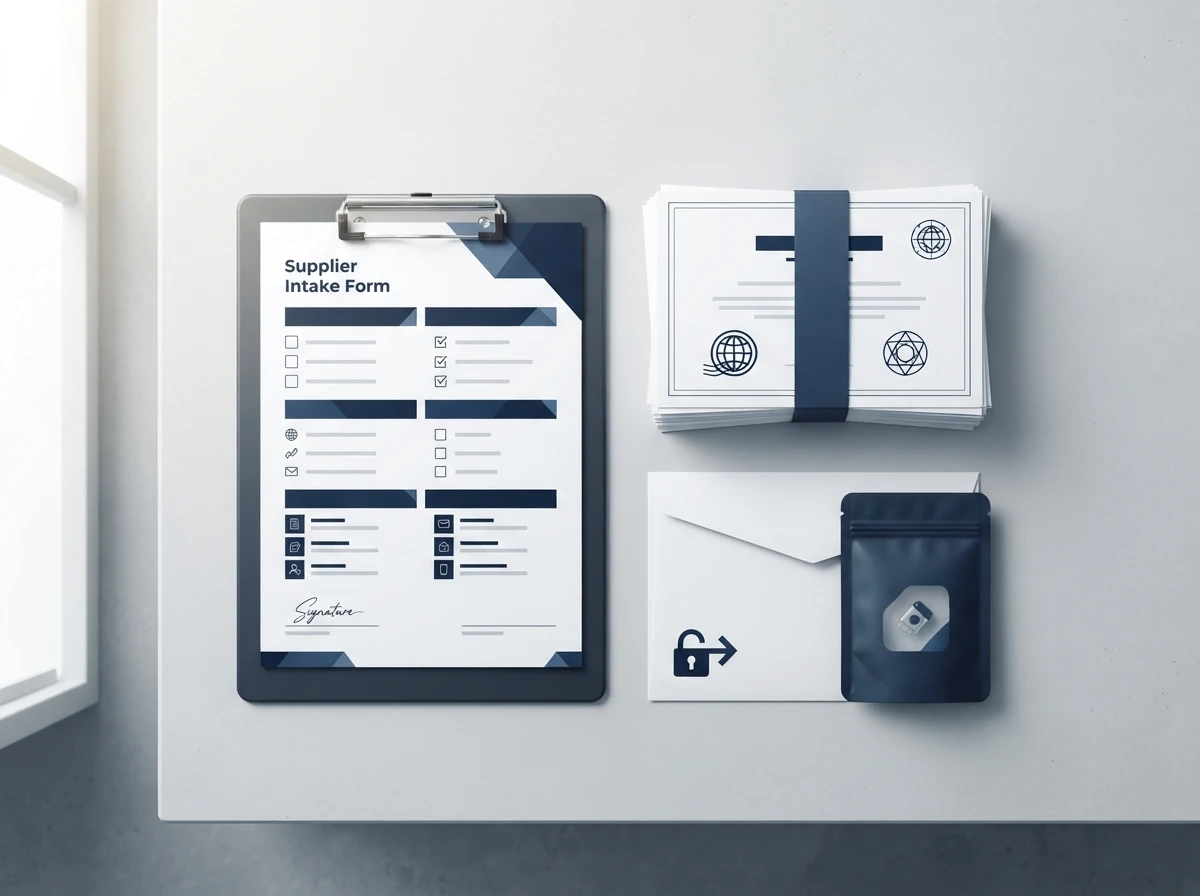
Vendor marketplace intake fails when teams either collect too little (can’t verify) or too much (nobody completes it). A minimal-but-complete supplier registration packet fits on one intake form with attachments, and it covers four buckets: legal identity, payment, capability, and compliance.
A minimal supplier registration checklist (the “first packet”)
| Bucket | Collect on the form | Attachments to request | Why it matters |
|---|---|---|---|
| Legal identity | Registered company name, registration number, address, website, tax/VAT ID, ownership/parent company if relevant | Business license or certificate of incorporation | Lets you match to a registry and prevents paying the wrong entity |
| Contacts and roles | Sales contact, quality contact, finance/billing contact, escalation contact | Org chart optional for higher-risk suppliers | Role separation reduces fraud and speeds issue resolution |
| Payment setup | Bank name, account name, account number/IBAN, SWIFT/BIC, beneficiary address, payment terms | Bank letter or voided check (region dependent) | Prevents misdirected payments and supports audit |
| Capability and scope | Product scope, materials/processes, MOQ, lead time, capacity constraints, QC process, Incoterms, warranty/returns | Product catalog, test reports if applicable | Stops “we can do anything” suppliers entering without proof |
| Compliance | Sanctions and restricted party screening fields, conflict minerals if relevant, ESG declarations, data security if relevant | Certifications (ISO, BSCI, FSC, FDA/CE where applicable), compliance questionnaire | Aligns to your risk profile and customer requirements |
Keep your first packet tight. For most teams, the biggest time-saver is asking for product scope and lead times up front, because it prevents onboarding suppliers that can’t actually ship what you need on your timeline.
If you need a clean way to turn this into a scoring file later, start with a scorecard structure now. You can borrow fields and weighting ideas from supplier scorecard examples you can copy and adapt them to your category risk.
Where marketplace evidence can pre-fill or cross-check fields
Vendor marketplaces are noisy, but they contain signals you can use to pre-fill or challenge what a supplier claims in supplier registration:
- On Alibaba, check verification indicators such as Verified Supplier, business type hints (manufacturer vs trading company), and Trade Assurance availability on the seller profile and listing context. Alibaba documents how Trade Assurance works and what it covers in its help content, including dispute and payment protection mechanics: Alibaba Trade Assurance overview.
- Tenure and activity: years active on-platform, response rates, and transaction-related badges can support a plausibility check against “established since” claims.
- Ratings and review volume: useful as a weak signal, but only when you also look at consistency across multiple listings.
- Repurchase or reorder signals (where shown): they can indicate repeat business, which is more meaningful than a single low advertised price.
- Quantity-tier pricing: this is where many sourcing teams get misled. A listing headline price can be a tiny MOQ tier or a promotional range. Capture the tiered price table as evidence and align it with the MOQ and lead time the supplier submits.
BuyerPilot’s core workflow is built around turning those marketplace signals into a ranked, deduplicated shortlist directly inside Alibaba and 1688 pages, including quantity-aware pricing and seller signals with confidence. If you want to see the exact signals it extracts for Alibaba pages, the Alibaba supplier ranking workflow page shows how the ranking panel is used during research.
How do you validate submissions and avoid duplicate supplier records?

Validation is where supplier registration becomes real procurement control instead of form-collecting. The goal is simple: the legal entity, the bank beneficiary, and the operating contacts should tell the same story.
Validate submissions with a repeatable set of checks
Start with checks that are fast, objective, and easy to train:
- Registry match (legal identity): confirm the registered name, registration number, and address match a government or official registry where available. For many countries, you can use official government registries; in the US, state-level business registries are linked from USA.gov state business resources.
- Document coherence: the company name on the business license should match the bank account name (or you need a documented reason, such as a parent company or approved payment agent).
- Bank verification: require a bank letter or equivalent evidence appropriate to the region, and run a basic “beneficiary name match” control. Payment fraud often enters through last-minute bank detail changes, so lock a change-control rule: bank updates require a second approver and out-of-band verification.
- Contact-role separation: if the same person is sales, finance, and quality, treat it as higher risk. It can be legitimate for small firms, but it changes how you manage controls and escalation.
For China sourcing specifically, it is also worth validating that the factory address provided aligns with what you see in marketplace profiles and audit reports. If your workflow includes choosing between manufacturers and trading companies, align registration fields to that decision using manufacturer vs trading company indicators so the “type” is evidence-based, not a self-declared checkbox.
Deduplication: stop creating three vendors for the same supplier
Duplicate supplier records are not an admin annoyance. They break spend visibility, hide performance issues, and create payment risk.
A minimal deduplication rule set before creating a vendor master record:
- Treat registered company name + registration number as the primary key when available.
- Use bank account + SWIFT/BIC as a strong secondary key.
- Use address + website domain + primary phone as supporting keys.
- Store known aliases: trading names, English names, and local-language names.
Marketplace sourcing adds a specific duplicate problem: the same supplier appears across multiple listings and sometimes under slightly different storefront naming. BuyerPilot was built to handle that by deduplicating suppliers across listings during research so your shortlist starts clean. If duplicates are a recurring time sink for your team, automatic supplier deduplication for Alibaba and 1688 research shows the workflow and what gets consolidated.
If you need to defend your decision later, export matters. A screenshot does not survive an audit. A structured file does. BuyerPilot Pro supports exporting the supporting supplier intelligence into a spreadsheet via supplier CSV export for audit and team sharing, which is the format most procurement teams already use for approvals.
What happens after registration: onboarding, scoring, and approval?
After supplier registration, the next step is onboarding: setting the supplier up so they can actually operate within your supplier management system and your controls. This is where teams confuse “we collected documents” with “we can buy safely.”
A clean post-registration flow has three outputs: a vendor master record you trust, a risk-based approval status, and a supplier scorecard you can update over time.
Onboarding: turn the packet into operational readiness
Onboarding typically includes:
- Creating the vendor record in ERP or a supplier management system, with verified payment terms and tax fields.
- Defining what the supplier is approved to provide: product scope, factories or subcontractors permitted, and shipping terms.
- Setting communication paths: who receives POs, who handles quality claims, who handles invoice disputes.
If you source from both Alibaba and 1688, onboarding is also where you decide how you treat marketplace evidence. Alibaba is more export-oriented and English-friendly; 1688 is domestic China and often requires more translation and interpretation. BuyerPilot keeps both workflows consistent; the Alibaba vs 1688 sourcing differences page breaks down what changes in practice.
Scoring: a supplier scorecard should be evidence-first
A supplier scorecard is a structured way to compare and monitor suppliers using criteria that map to your risk and performance needs. In registration, you are mostly scoring “can we trust the entity?” In ongoing management, you score “can they deliver?”
A practical scorecard for new suppliers usually includes:
| Scorecard area | Evidence you can use immediately | What you measure later |
|---|---|---|
| Identity and compliance | License, certifications, sanctions screening, audit results | Recertification cadence, incident history |
| Commercial fit | Quantity-tier pricing, MOQ, lead times, Incoterms | Price stability, cost-down capability |
| Quality capability | QC process description, test reports, factory audit | Defect rate, claim cycle time, CAPA effectiveness |
| Marketplace signals (optional) | Verification badges, tenure, ratings, repurchase indicators | Trend changes, consistency across listings |
Supplier relationship management meaning, in practice, is keeping this evidence alive: updating the scorecard with actual delivery, quality, and responsiveness data, not just what was claimed during onboarding.
Approval: tie it to spend and risk, not paperwork volume
Approval should be risk-based. A low-risk packaging supplier might be “approved to buy” after basic registration and a sample check. A high-risk electrical product supplier might require certifications, a factory audit, and a first-article inspection before approval.
If you do factory audits, treat them as validation, not theatre. A good audit checks process control, traceability, calibration, incoming inspection, and subcontractor management. It also confirms the address and operations match what was represented in registration and marketplace profiles.
Frequently Asked Questions
What should a supplier scorecard look like?
A supplier scorecard should map to your risk and performance needs, with fields tied to evidence: legal identity, compliance, capability, quality system, pricing by quantity tier, and lead time. Keep the first version simple enough that it actually gets updated.
How do you evaluate your suppliers?
Evaluate suppliers in two phases: pre-approval (identity, compliance, capability) and ongoing performance (quality, on-time delivery, responsiveness, cost stability). Use documents and audits for the first phase, then real PO and inspection data for the second.
What are the 5 key supplier evaluation criteria?
Most teams can cover the core risk with five: legal identity, payment integrity, compliance, capability fit (scope and lead times), and quality system. Add category-specific criteria only when they change the decision.
What does supplier information mean?
Supplier information is the set of data fields and documents that define who the supplier is, how they get paid, what they are approved to provide, and what evidence supports those claims. It is the backbone of your vendor master record and audit trail.
Supplier registration works when it is strict on identity and payment, clear on product scope and lead times, and lightweight everywhere else. Start by drafting a one-page intake form, define your validation checks, and enforce deduplication before any vendor record is created. If your team sources on Alibaba and 1688, use marketplace signals to pre-fill and cross-check claims, then export your supporting evidence so approvals stay defensible when the pressure to “just place the order” hits.